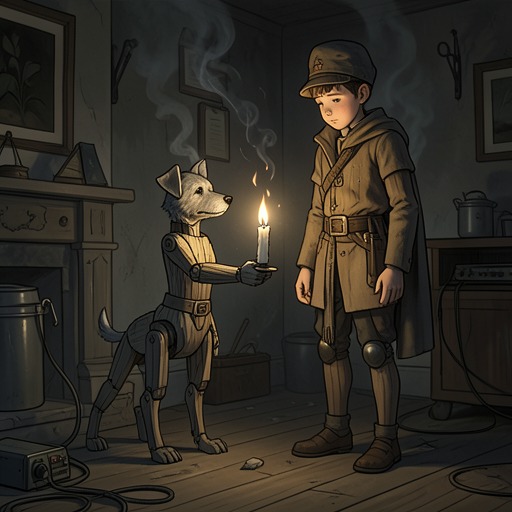
Pinocchio leaves for the Land of Toys and turns into a donkey
The Adventures of PinocchioPinocchio’s departure for the Land of Toys turns a promise of reform into a literal transformation: the boy who expects to become human instead becomes a donkey, his body reshaped by the idleness he chose. The change unfolds in stages, from a night journey with Lamp-Wick to five months of play, then from the first startling growth of Pinocchio’s ears to a public performance in which he is displayed as an animal.
The promise tested by temptation
The choice comes on the eve of the day when Pinocchio expects to stop being a Marionette and become a boy. Excited by that prospect, he tells Lamp-Wick that his transformation is imminent and invites him to the celebration. Lamp-Wick counters with a different promise: the Land of Toys has no schools, teachers, or books, and its calendar seems to make every day a holiday. The appeal is not merely escape for one afternoon; it is a whole country organized around never having to study.
Pinocchio recognizes the attraction but initially refuses. He says he has promised the Fairy to become good and intends to keep his word. He also has a practical reason to hurry home: the Fairy expects him back before night. His repeated refusal gives the scene a clear point of choice. He knows what he has promised and what Lamp-Wick is offering, and for a time he acts in accordance with that promise.
As the evening darkens, a small light appears in the distance. Lamp-Wick identifies it as the wagon coming to fetch him and asks Pinocchio once more. Pinocchio again says no, even as Lamp-Wick celebrates the wonderful country ahead. The wagon’s arrival changes the pressure of the scene: the invitation is no longer an abstract fantasy but a departing vehicle and a friend about to leave. Pinocchio eventually obeys the pull of that invitation, and the wagon carries him away from the home and reform he had said he wanted.
Arrival in a country without school
The wagon travels quietly, its wheels bound with straw and rags. Toward dawn, it reaches the Land of Toys. The country’s population consists entirely of boys, from about eight to fourteen years old, and its streets make play into a ceaseless public spectacle. Groups play marbles, hopscotch, ball, tag, and blindman’s buff; others ride bicycles or wooden horses, perform circus tricks, sing, recite, or parade with cardboard soldiers. The noise is so overwhelming that the narrator describes the need to put cotton in one’s ears.
The buildings and squares reinforce the boys’ rejection of school. Small wooden theaters fill the squares, while charcoal writing on the houses celebrates the Land of Toys and calls for an end to arithmetic and school. These details give visible form to Lamp-Wick’s earlier sales pitch: the place is not simply somewhere with extra playtime, but a community whose public identity is defined against study. Pinocchio has entered the world his companion promised him.
For five months, Pinocchio and the other boys play from morning until night. During that time they see no books, desks, or school. The long interval matters: the transformation is not presented as a sudden mishap unrelated to their conduct, but as the consequence that arrives after an extended season of chosen idleness. The narrator foreshadows the reversal by warning young readers that an unhappy surprise awaits Pinocchio, while the time spent in carefree play makes the change all the more abrupt.
The first bodily sign
One morning Pinocchio wakes and reaches for his head. His ears, which had been so small they were almost invisible, have grown at least ten inches overnight. Unable to find a mirror, he fills a basin with water and looks at his reflection. The basin becomes an improvised mirror, and the familiar body he expects to see is replaced by the unmistakable ears of a donkey. The transformation first appears not as a distant threat but as a change Pinocchio can inspect for himself.
A Dormouse explains the condition as donkey fever. Within two or three hours, the Dormouse warns, Pinocchio will no longer be a Marionette or a boy but a real donkey like those that pull fruit carts to market. The explanation gives a precise timetable to the danger: the ears are not an isolated oddity, but the first visible stage of a process already under way. Pinocchio begins to understand what is happening, yet understanding comes only after he has spent five months in the life Lamp-Wick praised.
From laughter to braying
Lamp-Wick is stricken by the same misfortune. When the two friends see each other’s ears, they initially make fun of one another rather than show sorrow or shame. Their laughter continues until Lamp-Wick suddenly falters, turns pale, and asks for help because he can no longer stand. Pinocchio admits that he cannot stand either; his laughter gives way to tears as he stumbles helplessly. The comic exchange collapses into physical crisis in a matter of moments.
Both fall onto all fours and begin to run and jump around the room. Their arms turn into legs, their faces lengthen into snouts, and long gray hair covers their backs. The appearance of their tails marks the change as a source of shame and grief. They try to cry and lament, but the sounds that come out are donkey brays. The reversal is complete: the boys who had treated their shared misfortune as a joke can no longer speak as boys, and their bodies make the consequence audible as well as visible.
A trained animal on display
The Little Man, the driver who brought the boys to the Land of Toys, comes to the door as the transformation takes hold. Pinocchio’s fate then moves from bodily change to enforced labor. His master tells him that he is expected to earn money, not merely receive food and drink, and sets him to learning jumps, bows, waltzes, polkas, and even how to stand on his head. Pinocchio has to learn whether he likes it or not. Training lasts three months and costs him many lashings before his master considers him ready.
The result is announced through posters advertising a great spectacle and the first public appearance of the famous donkey called Pinocchio. His body, first made into an object of astonishment when he discovers his ears, is now deliberately trained and exhibited for an audience. The promised freedom from lessons has led not to self-directed play but to another form of discipline, imposed by a master who turns the donkey’s tricks into a source of income.
During the performance, Pinocchio sees a beautiful woman in a box wearing a gold chain and a large medallion bearing the picture of a Marionette. He recognizes the image as himself and the woman as The Fairy with Azure Hair. The recognition joins his present animal form to the identity he has lost, and he tries to cry out to her. The scene thus closes this stage of the event not with the expected celebration of his becoming a boy, but with a public display of his donkey body and the sudden sight of the person associated with his hoped-for change. His departure from the Fairy’s promised path has produced a reversal visible to the crowd—and painfully legible to Pinocchio himself.